Green paper on ADHD in Iceland, waiting lists and medication use

Updated: Dec 17, 2025
Among the Nordic countries Iceland has the highest use of ADHD medication while waiting lists for diagnosis and treatment are getting longer. The minister of Health therefore appointed a committee in December 2023 to write a green paper on the situation by meeting relevant stakeholders, going through data and the literature. The objective was to identify 5-10 key findings to guide authorities regarding next possible steps. The committee handed over the report in December 2024. The report was published in the government consultation portal where the public and stakeholders had the opportunity to comment (link).
In recent years the waiting list for diagnosis and medication treatment has been a hot political topic where the ADHD association was asking authorities for action against long waiting lists for diagnosis and medication. At the same time health care professionals were raising red flags because of the high prevalence of medication use, almost only methylphenidates and amphetamines.
Recruiting objective members for the committee in these controversial circumstances was a challenge. The members of the committee were appointed from three ministries: the ministry of health, the ministry of social affairs and labour, and the ministry for children and education. Furthermore, the ADHD association had a representative.
Green Papers are designed to stimulate debate and raise specific issues at a national level. They are prepared from a consultative perspective, so that stakeholders are invited to express their views on the issue. It was suggested to the committee to meet with representatives of the health service, professional associations, patient organizations, the Directorate of Health, the Icelandic Health Insurance Fund, and the Icelandic Medicines Agency. The committee was led by the ministry of health and had over twenty meetings with various stakeholders.

Members of the committee decided to divide the process into two; children with ADHD and adults with ADHD which simplified the work considerably. The process of writing a green paper is not academic but takes a snapshot of the current situation through the eyes of regulators, service providers as well as those in need of services. It gave different stakeholders the opportunity to reflect on the previous and current situation as well as the opportunity to suggest a solution. The committee heard different opinions on prevalence, views stating overdiagnosis and overtreatment and underdiagnosis. The quality of some of the diagnostical process currently in use was questioned as well as the transfer of diagnostic data between systems. Structure of society, role of social media and school/work environment was also discussed and how it can influence disabling symptoms of ADHD and the increased prevalence of ADHD diagnosis followed by long waiting lists.
The second part of the work after the interviews was to go through the literature searching for evidence and follow up on some suggestions given by participants. This part of the work was divided between members of the committee as well as writing the report.
Results and key findings
In 2024 6.3% of the Icelandic population were taking ADHD medication with overall no gender differences (link). The number of defined daily doses (DDD) per thousand inhabitants per day was almost threefold in 2023 compared to the average use of the other Nordic countries (figure 1. link 1, link 2).
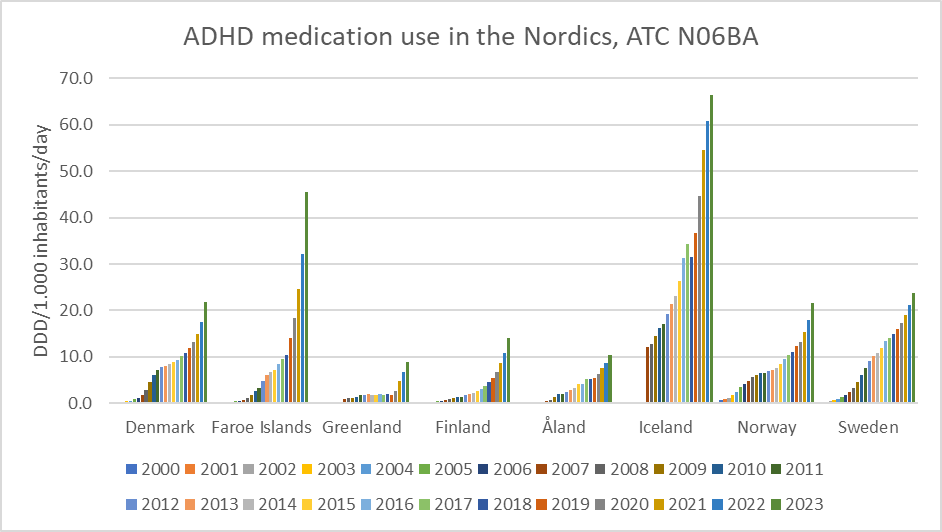
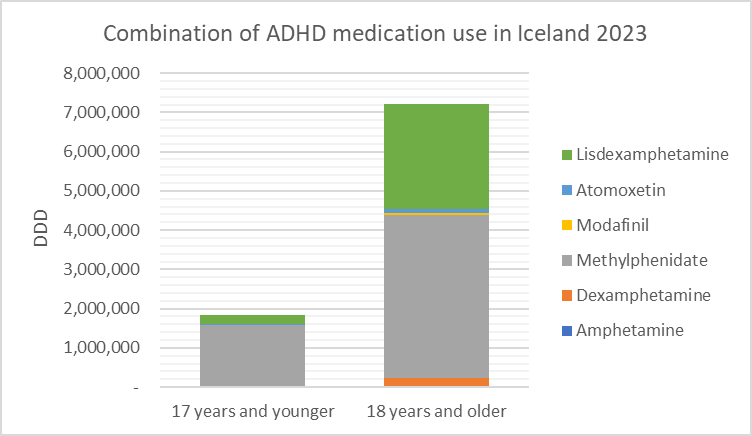
It is thought evident that all Nordic countries are experiencing a steep rise in the use of methylphenidates and amphetamines in 2023 (figure 1). Breaking down the usage in Iceland by age and molecules, 17 years and younger are prescribed about 20% of DDD´s and adults 80%, while adults are 68% of the individuals.
Methylphenidate was the most used molecule in 2023 counted in DDD´s with 63.2% and second was lisdexamphetamine with 32.1% (figure 2). The non-addictive medicine available in 2023, atomoxetine accounted for 1.4% of the use in 2023.
Looking at gender differences by age groups shows that boys are 62% of those receiving medication in the group aged seventeen and younger while females were 53% in those eighteen years and older (figure 3).

To get reimbursement for ADHD prescriptions, a physician with specialisation in psychiatry, must apply for it. The application must be according to a procedure which follows clinical guidelines set by the public insurer. Figure 4 shows a steep increase in the number of new individuals, never on ADHD medication, getting reimbursement. There is a moderate 5% increase between 2018 and 2019 mostly in the older than 26 years group but in 2019-2020 there is a 26% increase.

Looking at sales data in molecules for the same period we see that there is a new player on the market, lisdexamphetamine (figure 5). This raises the question whether the marketing of a new treatment is increasing the pressure on new diagnosis and treatment of ADHD.

During the working process of the committee an article was published in Læknablaðið (The Journal of The Icelandic Medical Association), stating that high prevalence of ADHD medication treatment indicates that ADHD is overdiagnosed in Iceland (link). The study found that in the year 2023 17.7% of boys 7-17 years of age used ADHD medication and 11.6% of girls. The results were even higher for the age group 12-17 years; 20.1% of boys and 14.6% for girls. Furthermore, the study found that the increase in use for men aged 18-44 was 414% and 543% for women from 2010 to 2023. Overall, the study found that the prevalence of ADHD in Iceland based on medication use, is about 2-3-fold compared to thorough international studies.
Based on interviews with stakeholders, collected data and the literature the committee identified the following key findings and recommendations:
Coordinated and high-quality diagnosis: (DSM-5/ICD 11, functional Impairments in two out of three areas (social, educational, and professional impairments, increased risk of accidents and mortality, and reduced quality of life)).
Education for both professionals and public. ADHD is overdiagnosed, education is needed regarding what is ADHD and what not. Patients are often disappointed if they don’t get stimulants for treatment.
Holistic approach – not only medication.
Correct medication use and follow-up. There is a lack of regular medication review and proportion of adults are on very high doses.
Early intervention and family support
School environment:
Educate teachers, social media, environment, school psychologists, therapists etc., information does not travel from the school system to the health system – double or triple diagnosis
Waiting lists:
Waiting lists should be screened and prioritized based on impairment.
Other resources need to be offered during waiting times that can shorten the recovery of clients.
Data is needed on prevalence of ADHD in Iceland.
Discussion
It is apparent that the diagnosis and treatment in Iceland of ADHD have been marked by quantity rather than quality. All data points to overdiagnosis and over prescription. The latest driver for an increase in prescriptions is probably new treatment options for adults, lisdexamphetamine. Boys are more often on treatment than girls and in the elderly group females, with overall no gender differences. Addictive medicines are used almost solely, and other treatment options are lacking. Key findings are similar as published in the UK (link). The prevalence of ADHD medication use in Iceland has now reached similar volume as in the Amphetamine epidemic in the seventies which ended with the substance act (link). The use of amphetamines and amphetamine like medications (methylphenidate) have now the shape and size of a prescription driven epidemic not unlike the recent opioid epidemic as described in the US by Norman Miller (link). The role of all stakeholders must be considered, including in the marketing of ADHD medication, the risk of addiction and other long-term consequences must also be kept in mind. Long term studies are needed! □