TMS as a last resort: Interview with Jonas Montvidas

Recently, we have been observing how transcranial magnetic stimulation, a non-pharmacological treatment method, is challenging the traditional dominance of medication in psychiatry. Today, I am talking about the practical aspects of this treatment method with Jonas Montvidas, a psychiatrist and enthusiast of this method.
Goda Tikniūtė: What is your experience with TMS? What disorders have you treated most often in your practice?
Jonas Montvidas: At Kaunas Clinics Hospital of Lithuanian University of Health Sciences, we mainly use TMS to treat treatment-resistant depression – when at least two antidepressants have been tried during the same episode of depression, each for at least a couple of weeks, without success. We have also treated several patients with obsessive-compulsive disorder and several with negative symptoms of schizophrenia.
In your opinion, which disorders are patients not receiving this treatment for, even though scientific evidence shows that they would benefit significantly from it?
The best results are seen in patients who have not been ill for very long. Young people who experienced an episode of depression after a long period of remission benefited the most. If a person has been ill for 30 years and has tried a number of medications and treatments, TMS is not as effective, but even in such cases, when assessing the effect on a scale, we saw at least some improvement. Some of the delayed cases are referred by doctors who no longer know what to do and send the patient for TMS to try. In Lithuania, TMS is usually not considered when prescribing a second AD that is not effective enough. TMS is usually sent as a kind of exceptional treatment method when no medication works anymore. This is not a good tactic.
We could also treat the negative symptoms of patients with schizophrenia using TMS without prescribing additional medication and without the risk of additional interactions or side effects.
What does a typical patient who comes to you for TMS treatment look like?
When we first started using TMS, we mostly saw "hopeless" patients, especially those for whom nothing else worked. These patients were referred to us by doctors who were open to new treatments, who had been treating these patients for about 20 years and who were still not getting better. The effect was, of course, limited for them, as they often had comorbid personality disorders and other causes of their depression, and TMS alone could not help them. Later, as the practice expanded, there were more younger patients who had not been ill for as long, and we referred patients who met the criteria ourselves, achieving a therapeutic effect in an increasing number of patients.
In your opinion, do evidence-based medical principles outweigh provisions and traditions in today's practice?
As with other innovative treatment methods, there is noticeable skepticism and despair among older and more experienced psychiatrists, mixed with high expectations and perhaps even a subconscious desire for the treatment to fail.
Interesting. How would you interpret this?
Essentially, it is not very pleasant to refer your patient to a colleague – in a sense, it is like admitting your failure as a doctor to both the patient and the other doctor. I think this is one of the reasons why referring patients is postponed.
The chances of success are also sabotaged by expecting an unreasonably high response and referring very severe cases. So, in fact, it is very helpful to use scales and define what we consider to be improvement. After all, it is not the case that a patient will come to TMS in a very serious condition and leave healthy. This is not some kind of miracle method. I think we need to set realistic expectations and select patients whom we can help.
Can we say that there is polarization among psychiatrists and/or patients regarding this treatment method?
If polarization can be considered the skepticism of some specialists, especially the older generation, as opposed to the enthusiasm of psychiatrists interested in scientific innovations, then yes, there is, and the reason, in my opinion, is the discrepancy between how scientists define improvement in scientific research and how practitioners see it, and what patients expect. I have participated in several training sessions where it was said that we need to change our perception of what improvement is. For example, if more experienced colleagues expect that effective treatment means that a person will recover and no longer complain, this does not correspond to what scientists define as improvement in scientific research. Most often, the effect will manifest itself as an improvement in daily functioning, a reduction in some symptoms, with the person remaining ill, with the same complaints, which will simply be reduced. When we treat such a difficult patient and they say, "Well, it didn't help, it didn't improve, it won't help," we must clearly understand that skepticism arises from unrealistic expectations.
When is TMS prescribed as an adjunctive therapy, and when is it prescribed as an alternative to medication?
By definition, TMS should not be prescribed as an alternative to medication. In private practice, I have had to work briefly with this method, and if the person pays for it themselves, and as the method is relatively safe, TMS alone can be prescribed, but otherwise, all recommendations state that TMS should be prescribed alongside antidepressants and/or other medication. However, in private practice, TMS is sometimes combined with psychotherapy, especially CBT, because everything takes place within a very clear structure.
Jonas Montvidas: "When we first started using TMS, we mostly saw "hopeless" patients, especially those for whom nothing else worked. These patients were referred to us by doctors who were open to new treatments, who had been treating these patients for about 20 years and who were still not getting better.
For which disorders is the evidence strong, and for which is it still preliminary?
The highest level of recommendation and the highest level of evidence strength is for the treatment of depression. There is no doubt about this. There is strong evidence for the treatment of obsessive-compulsive disorder. Here, the effectiveness varies depending on the equipment available, as deeper brain structures need to be stimulated than in the case of depression treatment, but it is also clearly proven. There is also evidence for the treatment of eating disorders-here the evidence is of a lower level-as well as for the treatment of alcohol addiction. It is not yet FDA approved in the United States, but research is actively underway in this direction, with attempts to stimulate different areas and different locations. By stimulating the vermis of cerebellum, it is possible to treat the negative symptoms of schizophrenia. Such studies have been conducted in the Netherlands, with very good results. So far, this is still more experimental evidence.
What could we attribute the skepticism towards TMS in the psychiatric community to?
I think it is related not only to the unreasonable expectations I mentioned, but also to some lack of knowledge, because sometimes psychiatrists think that it is painful, very risky or dangerous, or complicated. But in fact, it is very simple. Even residents who come in are apprehensive at first, but then they see that it's all very simple.
And what about the patient community? Some probably find TMS attractive because it’s pills free, but what about the others?
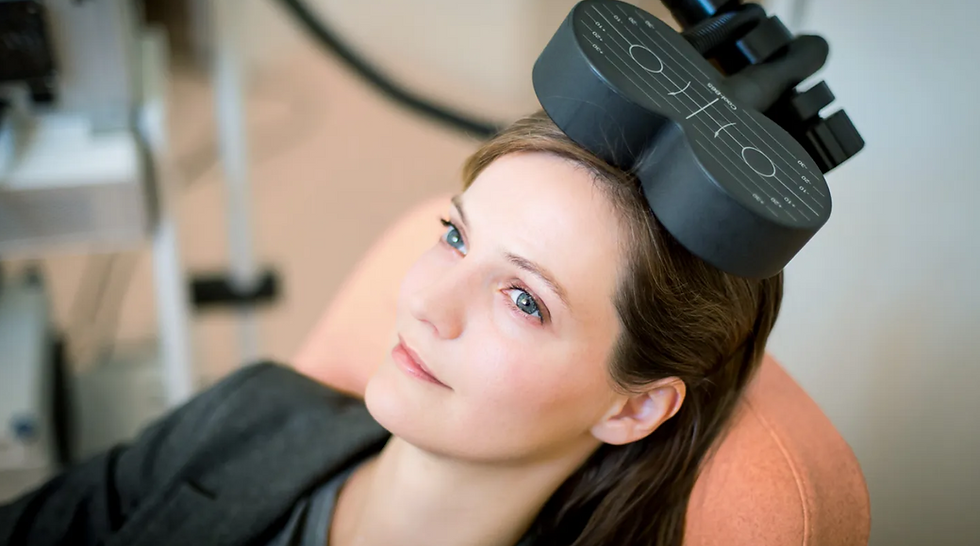
There is much less skepticism among patients than among doctors. There is very little fear when TMS treatment is offered, just a general apprehension, questions like "Will it really hurt?" "Is it safe?" The worst part is usually the logistics, because patients have to come in for several days in a row, putting in more effort and time. I often remind patients that the success of their treatment depends more on them than on me, because it is our joint effort to make them feel better. They have to do something, and one of those things is coming to TMS sessions. It can be a little uncomfortable and complicated. But I have noticed that for people who are really suffering and want to get better, this is not a major obstacle. But those patients who are deeply depressed are either in regression or their intrapsychic structures are not capable, and they want someone to take care of them. And in fact, the doctor lays the patient down, asks if he is lying comfortably, puts a coil on his head, and thus takes care of him. This is also a kind of intervention in a psychotherapeutic sense-a psychotherapeutic-like relationship emerges, and this also becomes part of the treatment.
What message to go would you like to convey to the psychiatrists reading our conversation?
As with all new treatment methods, the answer is: don't wait. The inclusion criteria and indications are there for a reason. So if you have a patient, say a 20-year-old girl, who has been ineffectively treated with one, then with a second antidepressant for several weeks, don't hesitate to send her for TMS, because then the effect will definitely be better than if you treat her for a long time, she will experience many unpleasant sensations, she will be disappointed, her expectations will not be met, and then it will be much more difficult in the future.
So the most important message is - don't wait, don't be afraid, and don’t hesitate to refer your patients as soon as possible.
Thank you for the conversation. □